

Materials on selecting and working with equipment
We collected practical articles to help with equipment selection, operation, consumables and service.
How to Choose a Fiber Laser Cutting Machine for Metal
A practical guide to choosing a fiber laser cutting machine around the real production flow: materials, thicknesses, sheet format, power, cutting head, assist gas, automation, service, and site infrastructure.
Open article→02ART-002Dedicated Tube Laser or Combined Sheet + Tube Machine: Which Should You Choose?
Helps choose between a dedicated laser tube cutter and a combined sheet + tube machine by comparing real machine hours, queues, automation, product mix, and growth plans.
Open article→03ART-003Why More Laser Power Does Not Always Increase Production Throughput
Explains when more laser power really increases output and when throughput is limited instead by piercing, loading, sorting, downstream operations, programming, or production planning.
Open article→04ART-004Why a 3.2 m Press Brake Is Not Always the Best Choice: One Large Machine or Two Compact Ones
Explains when one 3.2 m press brake is justified and when two compact presses can improve production flow through parallel work, shorter queues, and fewer changeovers.
Open article→05ART-005Cutting-head ceramic ring: what it does and how to choose the right one
Explains the role of the cutting-head ceramic part in the lower nozzle assembly, its connection to capacitive height control, common fault signals, and the compatibility logic required for correct selection.
Open article→06ART-006How to Choose a Press Brake: Length, Force, Tooling, and Your Real Part Mix
Explains how to choose a press brake around the real part mix: bend lengths, required force, V-die opening, tooling, backgauge, changeovers, and actual production loading.
Open article→07ART-007Laser Welding With and Without Filler Wire: When Is Wire Needed?
Explains when laser welding is better performed without filler and when filler wire is needed to bridge part of a gap, build weld volume, or control weld-metal composition.
Open article→08ART-008Automatic or Manual Tube Loading: When Automation Actually Improves Throughput
Explains when manual, semi-automatic, or bundle-automatic tube loading really reduces tube-laser waiting time, and when frequent profile changes make a simpler loading approach more rational.
Open article→09ART-009Crowning on a Press Brake: Why Deflection Compensation Is Needed
Explains why the ram and bed of a press brake elastically deflect under load, how crowning helps equalize the angle of a long bend, and which errors it does not correct.
Open article→10ART-0102D and 3D Machine Vision in Robotics: When Do You Need a Spatial Model?
Explains how to choose between 2D and 3D machine vision for robotics based on scene geometry, the required part pose, accuracy, calibration, surface properties, and cycle time.
Open article→11ART-011How to Choose Protective Glass for a Cutting Head and Avoid Compatibility Mistakes
Explains how to select protective glass for a cutting head by the exact head model and window position, geometry, cartridge, coating, wavelength, and catalog data rather than diameter alone.
Open article→12ART-012Cutting Stainless Steel with Protective Film: Direct Cutting or Separate Film Processing
Explains why protective film can change stainless-steel cutting stability, when direct cutting through the film may be viable, and when separate film processing or local removal is needed.
Open article→13ART-013How to Calculate Real Laser Machine Utilization Before Purchase
A practical model for estimating laser-machine utilization before purchase: machine hours, cycle time, blocking auxiliary time, changeovers, available calendar, and peak scenarios.
Open article→14ART-014Why a fast laser sits idle: CAM, nesting, and planning as a hidden bottleneck
Explains why a fast laser can sit idle because CAM programs, nests, material, the job queue, or downstream operations are not ready—even when the machine itself is technically available.
Open article→15ART-015Why CO₂ Lasers Lost Ground to Fiber Lasers in Metal Cutting
Explains why fiber lasers displaced CO₂ in most metal-cutting applications: absorption, beam delivery, energy efficiency, service, speed, and technology scaling — without claiming that CO₂ became useless.
Open article→16ART-016Cutting-Head Parts Passport: What to Record Before the First Emergency Purchase
A practical guide to building a cutting-head parts passport that records the head model, manufacturer part numbers, compatibility evidence, and stock data before an emergency purchase.
Open article→17ART-017How Robotization Really Improves Productivity: Robot Speed or Eliminating Waiting?
Explains how robotization improves throughput by reducing waiting, enabling proven parallel work, stabilizing the cycle, and balancing the entire robotic cell rather than focusing only on robot speed.
Open article→18ART-018How to Make Robot Bin Picking Reliable: What Stable Part Grasping Requires
Explains when random bin picking can work reliably in production: from 3D data and part visibility to grasp points, tool geometry, collisions, rescanning, recovery logic, and testing on a real bin.
Open article→19ART-019How to Run a Comparative Laser-Welding Test With and Without Filler Wire
A practical method for comparing laser welding with filler wire and autogenous welding on real parts: common quality criteria, process-window checks, repeatability, and full accepted-part cycle time.
Open article→20ART-020How to Plan a Tube Laser Cutting Area: Stock, Unloading, Aisles, and the Real Footprint
Explains how to estimate the real footprint of a tube-laser production area from long stock, loading, unloading, aisles, buffers, service access, and future automation reserve—without universal distance rules.
Open article→21ART-021How to Estimate the Real Throughput of a Bending Area with Short Batches
A practical model for estimating bending-area throughput with short batches: cycle time, setup and changeover, tooling, operator availability, queues, and part movement.
Open article→22ART-022Emergency Spare-Part Request: What to Send the Supplier Right Away
A practical structure for an emergency spare-part request: how to send machine, module, marking, photo, interface, and symptom data so the supplier can confirm compatibility.
Open article→23ART-023When Production Really Needs MES/APS — and When Simpler Rules Are Enough
Helps distinguish problems that genuinely justify MES or APS from situations where order-readiness discipline, clear dispatching rules, or point integrations are enough.
Open article→24ART-024How to Qualify a New Batch of Stainless Steel with Protective Film Before a Production Run
Explains how to qualify a new batch of stainless steel with protective film before production: identify the sheet and film, choose representative tests, evaluate direct cutting or a separate film-processing route, and record the accepted route for the specific batch and machine configuration.
Open article→25ART-025How to Time-Study a Robotic Cell and Calculate Cycle Time Correctly
A practical robotic-cell time-study method: how to define cycle boundaries, separate sequential and parallel operations, waiting, changeovers, and downstream constraints without double-counting time.
Open article→26ART-026How to Test a Press Brake Before Purchase: Sample Parts and Acceptance Criteria
A practical method for testing a press brake before purchase: how to build a representative set of your own parts, agree acceptance criteria in advance, and assess accuracy, repeatability, changeovers, tooling, and the real production cycle rather than one showcase part.
Open article→27ART-027Machine Vision on Shiny Metal: How to Run a Real Acceptance Test
A practical acceptance-test method for machine vision on shiny, dark, and contaminated metal parts: how to build a representative sample, assess the complete cycle rather than a single image, and make a decision before buying the system.
Open article→28ART-028Why Stainless Steel Shows Marks After Bending — and How to Test It Before Buying a Press Brake
A practical guide to marks on stainless steel after bending: how to distinguish acceptable contact from damage, prepare a press-brake trial, and verify tooling, protection and repeatable surface quality before purchase.
Open article→29ART-029Press Brake Axes: What Y, X, R and Z1/Z2 Do and How Many You Need
A plain-language guide to press brake axes: Y/Y1/Y2, X, R, Z1/Z2, backgauges, CNC controls and choosing a configuration from real parts.
Open article→30ART-030How to Verify Punch and V-Die Compatibility with Your Part and Press Before Ordering
A practical process for verifying a punch, V-die, part drawing and press before ordering: which data to prepare, how to check the bend route, and how to record a trial result.
Open article→31ART-031What Part-Mix Data to Gather Before Requesting a Laser Cutting Machine
A practical list of part, material, thickness, geometry, volume and process-route data to prepare before requesting a laser cutting machine.
Open article→32ART-0321500×3000 or 2000×6000 mm Working Area: How to Choose a Format for Real Sheets and Parts
Choose a laser working area from actual sheet formats, part sizes, order mix and shop logistics—not from the assumption that a larger table is always better.
Open article→33ART-033One Universal Laser or Two Specialized Machines: How to Compare Risk and Throughput
A practical comparison of one universal laser and two specialized cutting machines: throughput, downtime risk, logistics, cost and decision criteria.
Open article→34ART-034Open or Enclosed Laser Cutting Machine: What Changes for Safety, Service and Production
Open and enclosed laser cutting machines must be assessed from the specific model, safeguarding concept, site plan, process controls and service requirements—not from the visibility of the cutting area.
Open article→35ART-035One Table or an Automatic Exchange Table: When Does a Second Table Pay Back?
How to decide whether an automatic exchange table pays back on a laser cutting machine: cycle time, staffing, logistics, downtime risk and the actual part mix.
Open article→36ART-036Compact Laser or Full-Size Industrial System: Where the Practical Boundary Lies
Where the practical boundary lies between a compact and full-size laser cutting machine: part mix, logistics, service, automation and risk.
Open article→37ART-037New or Used Fiber Laser: How to Assess Technical and Financial Risk
How to compare a new and a used fiber laser: technical condition, history, service, documents, testing and total cost of ownership.
Open article→38ART-038How to Compare Two Laser Machine Quotations Without Falling into the Different-Configurations Trap
Two quotations for a laser cutting machine cannot be compared by the total price, source power, or number of PDF lines. First put them into one structure: the same production task, the same required functions, and separate columns for what is included, excluded, needs clarification, or depends on the site. Only then does the price become meaningful.
Open article→39ART-039What must be included in a technical specification for buying a laser cutting machine
What must be included in a technical specification for buying a laser cutting machine
Open article→40ART-040How to Check Whether a Supplier Selects a Machine for Your Parts Rather Than for a Stock Model
A practical way to check whether a laser machine has been selected for your parts: product mix data, a test, assumptions, configuration, and questions for the supplier.
Open article→41ART-041When to Buy Laser Loading Automation Immediately and When to Leave It for a Second Stage
How to decide whether sheet-laser loading automation is needed immediately: volume, sheet format, shifts, downtime, safety, payback, and a second stage.
Open article→42ART-042How to assess service availability before signing a laser-machine contract
Laser-machine service should be assessed before signing a contract, when the same questions can still be put to several suppliers, their answers compared and agreements recorded in writing. After delivery, the phrase ‘service is available’ often proves too general: it may be unclear who receives requests, which specialists are available, what can be done remotely, how spare parts are supplied and where warranty obligations end.
Open article→43ART-043Which reference parts to prepare for a laser-cutting demonstration before purchase
How to prepare representative parts for a fair laser-machine test: geometry, materials, acceptance criteria and comparison data.
Open article→44ART-044How to distinguish a showcase laser-cutting demonstration from a test that reproduces your production
Learn how to prepare a laser-machine test using real parts, which data to record, and why an attractive demonstration cut is not equipment acceptance.
Open article→45ART-045Which laser-machine options actually affect the result, and which only increase the price
How to assess a fibre-laser configuration from your parts, work flow, and production conditions—without paying extra for unnecessary options.
Open article→46ART-046How to choose a laser configuration for frequent changes of materials and thicknesses
How to select a laser machine for a mixed product mix: materials, thicknesses, gases, changeover cycle, testing, and data limits.
Open article→47ART-047When does a large-format laser reduce unit cost, and when does it create unnecessary expense?
How to assess the economic boundary of a large-format laser: product mix, material, utilization, flow, scrap, floor space and cost.
Open article→48ART-048How to assess future expansion of a laser cell before buying the first machine?
How to allow for expansion before buying the first laser machine: space, flow, utilities, demand data, reserves and the limits of assumptions.
Open article→49ART-049Which laser-machine warranty terms need checking before an advance payment
How to read laser-machine warranty terms before an advance payment: subject, exclusions, claim procedure, response times and limits of liability.
Open article→50ART-050How to create a decision matrix for selecting a laser machine without subjective scores
A practical decision matrix for selecting a laser machine: criteria, evidence, weights, scenarios and limits of an honest comparison.
Open article→51ART-051Laser-source beam quality: what it changes in cutting thin and thick metal
What laser-source beam quality means and why it affects focusing and the choice of configuration for different parts.
Open article→52ART-052Modular or monoblock laser source: a decision for repair, spares and redundancy
“Modular” and “monoblock” describe the architecture of a specific product, not an automatically superior operating strategy.
Open article→53ART-053Back-reflection when processing copper and brass: how to constrain source selection to the actual context
Copper and brass do not constitute one universal risk scenario.
Open article→54ART-054Laser source power reserve: a decision based on the part mix and trial evidence
Power reserve is not a universal percentage above the “nominal requirement”.
Open article→55ART-055Delivery fiber routing and site planning: design based on the specific system's documentation
Fiber length, bend radii, protection and service access cannot be established from a general workshop layout.
Open article→56ART-056Autofocus acceptance: verifying an agreed scenario against the specific optics specification
Autofocus is accepted not merely because the function exists, but against an agreed scenario and the exact specification of the installed head or optics.
Open article→57ART-071Oxygen, nitrogen, or compressed air: how to choose an assist gas by material and edge requirements
Oxygen, nitrogen, or compressed air: how to choose an assist gas by material and edge requirements
Open article→58ART-111Why burr remains on the lower edge after laser cutting and how to find the cause
Why burr remains on the lower edge after laser cutting and how to find the cause
Open article→59ART-112Why a laser-cut edge becomes rough on only part of the contour
Why a laser-cut edge becomes rough on only part of the contour
Open article→60ART-131What makes up a laser-cutting cycle and where time is actually lost
What makes up a laser-cutting cycle and where time is actually lost
Open article→61ART-132How pierce count affects part manufacturing time more than metres of cutting
How pierce count affects part manufacturing time more than metres of cutting
Open article→62ART-133How to group orders by material and thickness without missing due dates
How to group orders by material and thickness without missing due dates
Open article→63ART-134Mixed nesting of parts from different orders: when it pays off and how to preserve traceability
Mixed nesting of parts from different orders: when it pays off and how to preserve traceability
Open article→64ART-135How to manage sheet remnants so they do not become dead stock
How to manage sheet remnants so they do not become dead stock
Open article→65ART-136When automatic nesting needs manual correction by a technologist
When automatic nesting needs manual correction by a technologist
Open article→66ART-137How to assess savings from common-line cutting on a real part mix
How to assess savings from common-line cutting on a real part mix
Open article→67ART-138Як порахувати вартість газу на одну деталь, а не на годину роботи верстата
Вартість газу на одну деталь рахують не за паспортною ціною балона і не за кількістю годин роботи верстата. Потрібно визначити фактичну витрату газу за одиницю часу, помножити її на час, протягом якого газ реально подається, і розподілити результат між…
Open article→68ART-139How to account for metal scrap in the cost of laser cutting
A practical method for separating finished parts, reusable remnants and scrap when calculating laser-cutting material cost.
Open article→69ART-140How to calculate the cost of an urgent order with changeover
How to account separately for changeover, queue interruption, a small batch, risk and actual time without an arbitrary rush surcharge.
Open article→70ART-141Why sheet-utilization percentage is not equal to nesting economic efficiency
Why the highest sheet-fill percentage can cost more: cutting time, piercing, risk, sorting, remnants and order lead time.
Open article→71ART-142How to verify the accuracy of estimated CAM program time
A method for verifying a CAM forecast: one data basis, correct cycle boundaries, grouping deviations, calibration and control after updates.
Open article→72ART-143Offline laser programming: when a separate technologist workstation pays back
When a separate CAM workstation removes a constraint from a laser machine: pilot data, an effect formula, licences, people, process and common errors.
Open article→73ART-144How to organize a library of validated cutting conditions without version chaos
A practical system for storing, validating, approving and retiring laser cutting conditions without inconsistent copies.
Open article→74ART-145Which laser-cell metrics do the manager, operator and technologist need?
How to separate laser-cell KPIs by role without mixing operational signals, technological causes and management results.
Open article→75ART-146How to calculate laser-machine OEE when downtime reasons are recorded inaccurately
How to calculate and interpret laser-machine OEE honestly when downtime codes are incomplete: formulas, boundaries, data quality and an improvement plan.
Open article→76ART-147Part sorting after cutting: when it becomes the cell's main constraint
How to determine whether manual separation and sorting constrain a laser cell, and what to change before purchasing an automated system.
Open article→77ART-148Automatic part unloading: which operations it removes and which remain
What sheet unloading and part picking automate after laser cutting, which manual operations remain and how to validate the product range before investing.
Open article→78ART-149How to prepare a laser-cutting department for an unattended second shift
A practical readiness audit for unattended laser cutting: stable jobs, material, process control, abnormal events and morning acceptance.
Open article→79ART-150How to verify the actual margin of laser-cutting orders
How to reconcile revenue, actual material, machine time, gas, labour, rework and commercial deviations to see the real margin of an order.
Open article→80ART-151Which floor and foundation requirements should be checked before installing a laser machine?
How to collect module weights, support points, loads, anchoring and flatness requirements, and installation-route data before a laser machine arrives.
Open article→81ART-152How to calculate electrical power for a laser together with chiller, compressor and extraction
How to compile a load schedule for a laser, chiller, compressor, dryer, extraction and automation, and pass it to the electrical designer.
Open article→82ART-153Voltage stabilizer, transformer or grid protection: what a laser cell needs
How to distinguish unsuitable voltage, sags, harmonics, imbalance and surges, and select a solution only after measurement and manufacturer requirements.
Open article→83ART-154How power interruptions affect a laser machine and which backup scenarios are realistic
How to prepare a laser cell for loss of power: safe shutdown, a control-system UPS, generator and recovery verification without false promises.
Open article→84ART-155What temperature and humidity the source, cutting head and electrical cabinet need
How to check the operating environmental limits of the laser source, cutting head, electrical cabinet and chiller separately, without inventing a universal range.
Open article→85ART-156How to prepare a laser work area for winter and prevent condensation
A practical winter procedure for a laser work area: acclimatization, dew point, chiller, inspection after cold exposure, and startup release criteria.
Open article→86ART-157How to size extraction for the actual fume load, not just the machine specification
How to determine the airflow and dust load for laser cutting extraction: process, table, zones, materials, ducts, filter, and acceptance tests.
Open article→87ART-158Filtration or outdoor discharge: how to choose a fume removal system
How to choose recirculation, outdoor discharge, or a hybrid system after defining the load: particles, gases, energy, permits, monitoring, and TCO.
Open article→88ART-159How to design the technical gas supply to a laser machine
How to collect oxygen, nitrogen, and air requirements, select a supply source, and calculate peak flow, pressure drop, and backup.
Open article→89ART-160Which fire safety requirements are critical for cutting without continuous supervision
How to assess fire scenarios in laser cutting without an operator: materials, slag, extraction, detection, stopping, suppression, and response.
Open article→90ART-161How to organize safe sheet storage near a laser work area
How to separate stock, WIP, remnants, and skeletons, check racks, loads, crane and forklift routes, and keep safety access clear.
Open article→91ART-162Which service zones should be left around the machine
How to overlay operating, service, installation, logistics, and emergency envelopes and verify that the machine can be maintained safely.
Open article→92ART-163How to prepare the network and remote service access without putting production at risk
How to inventory OT assets, segment the network, and organize a gateway/VPN, MFA, temporary access, logging, backups, and recovery.
Open article→93ART-164Which spare interfaces and utilities should be provided for future automation
A practical list of signal, data, network, safety, and mechanical provisions to agree before buying a laser when automation is planned for later.
Open article→94ART-165How to calculate the total cost of owning a laser over five years
A practical five-year TCO model for a laser cell: CAPEX, energy, gases, labor, service, downtime, working capital and residual value.
Open article→95ART-166Which costs are most often omitted from a laser cell's initial budget
Checklist of frequently omitted costs before the first production order: building work, power, gases, extraction, commissioning, training, stock and working capital.
Open article→96ART-167How to compare buying, leasing and staged expansion of laser capacity
How to compare three strategies by cash flow, utilization risk, available capacity, service, flexibility and five-year TCO.
Open article→97ART-168Which roles and competencies are needed to launch a laser cell
Who is needed before laser installation, SAT, ramp-up and production: role owners, competencies, authorizations, training, cover and a responsibility matrix.
Open article→98ART-169How to prepare a site-readiness checklist before the installation crew arrives
How to check the premises, base, electrical supply, gases, extraction, logistics and documents before the laser installation crew arrives.
Open article→99ART-170How to accept infrastructure after installation without confusing it with machine acceptance
How to accept the base, electrical supply, gases, extraction and network separately, then perform laser machine SAT without substituting evidence.
Open article→100ART-171Profile diameter or circumscribed circle: how to read a tube laser working range
Profile diameter or circumscribed circle: how to read a tube laser working range
Open article→101ART-172Mass per meter: why it matters more than maximum tube diameter
Why diameter alone is insufficient for selecting a tube laser and how to check mass per meter, stock length, clamping and support.
Open article→102ART-1732D, 2.5D or 3D head on a tube laser: which contours each option can produce
How to compare 2D, 2.5D and 3D tube-laser heads using actual part contours rather than the option name in a catalog.
Open article→103ART-174Two or three chucks: how the clamping arrangement affects remnant and tube-laser accuracy
How to choose a two- or three-chuck tube-laser arrangement based on stock length, remnant, accuracy, reclamping and the real production cycle.
Open article→104ART-175What a tube's ‘zero tail’ means and when it is genuinely achievable
How to distinguish end-of-bar processing from zero overall loss and verify the tube remnant on your own profiles and parts.
Open article→105ART-176Bundle loader, step magazine, or single-bar feed: what to choose
How to choose a bundle, step, or single-bar loader by batch pattern, profile changes, surface, labour, and urgent orders.
Open article→106ART-177How to choose tube-laser loading length for purchased metal formats
How to relate 6.5/9/12-metre tube-laser configurations to real supply lengths, parts, mass, nesting, logistics and floor area.
Open article→107ART-178What unloading length is needed for real parts, not an average order
How to determine the required unloading length from parts, trajectory, support, sorting, and logistics rather than from an average order.
Open article→108ART-179How a tube laser works with open profiles and why a separate check is needed
Why claims about C-, U-, L-, and special profiles are insufficient: clamping, orientation, support, head access, deformation, and test parts.
Open article→109ART-180When a tube laser needs weld-seam recognition
How to determine the need for seam recognition from the drawing, load, appearance, bending, and series stability.
Open article→110ART-181Compensation of profile bow and twist: which systems exist
Which compensation levels exist: referencing, measurement, programme correction, and result control for bowed or twisted profiles.
Open article→111ART-182When a bevel on tube justifies a 3D cutting head
How to compare a 3D bevel with separate edge preparation by parts, welding, accuracy, cycle, maintenance, and risk.
Open article→112ART-183How to choose a tube cutter for thin-wall stainless tube
How to check clamping, support, trajectory, gas, part removal, and cut quality before selecting a tube cutter for thin stainless tube.
Open article→113ART-184How to choose a tube laser for heavy profiles and thick-wall tubes
How to assess mass, clamping, support, power, 3D access, loading, and tube-laser FAT for heavy profiles and thick tubes.
Open article→114ART-185Which supports are needed for long, flexible, small-diameter tubes
How to determine support number, type, control, and location for long small-diameter tubes and verify stability in FAT.
Open article→115ART-186How to assess a tube laser's ability to cut short parts without loss or damage
How to verify minimum length, retention, final cut, unloading, sorting, and yield of accepted short parts.
Open article→116ART-187Do tube lasers need drilling, tapping and other follow-up operations?
How to assess flow drilling, drilling, tapping, beveling and marking options on a tube laser by part mix, quality and TCO.
Open article→117ART-188How to verify tube-laser software on your own assemblies and frames
A practical test scenario for tube-cutter CAD/CAM: import, joint development, simulation, nesting, NC, changes, time and acceptance of a completed assembly.
Open article→118ART-189When a tube laser replaces sawing, drilling and milling — and when it does not
How to determine from the part which operations can genuinely move to a tube laser and where sawing, drilling, tapping or milling should remain.
Open article→119ART-190Buy a tube laser or outsource tube cutting: how to calculate the decision point
How to compare an in-house tube laser and contract cutting by TCO, queues, risk, working capital, quality and demand scenarios.
Open article→120ART-191How tube bow affects hole positions along a part
How bow and sag change hole coordinates, what to measure in material, and how to check sensing, support, compensation and the finished part.
Open article→121ART-192How rectangular-profile twist changes cutout geometry
How twist rotates profile faces, shifts cutouts and joints, what to measure and how to check orientation, sensing and compensation.
Open article→122ART-193Why a tube weld seam must be oriented relative to future bends and holes
How to specify the longitudinal seam position relative to holes, bends and visible surfaces and verify repeatability on a laser tube cutting machine.
Open article→123ART-194How to optimise part nesting on a tube and control the end remnant
How to optimise part nesting, account for clamping and unloading, plan batches and track reusable tube remnants.
Open article→124ART-195Internal spatter after tube cutting: when it is critical and how to reduce it
When spatter and slag inside laser-cut tubes are critical, how to define a criterion, reduce adhesion and verify cleaning.
Open article→125ART-196How to avoid thin-walled tube deformation during laser cutting
How to control clamping, supports, contour sequence, heat and unloading to reduce thin-walled tube deformation.
Open article→126ART-197Why rectangular-profile corners cut differently from flat walls
Why geometry, speed and heat dissipation change at profile corners, and how to check parameters, toolpaths and transition quality.
Open article→127ART-198How to control cut perpendicularity on round tube
How to define a datum, measure the edge angle and separate process error from tube geometry, clamping and head toolpath effects.
Open article→128ART-199How to obtain a stable tube bevel for subsequent welding
How to connect bevel geometry with the welded-joint design, verify angle, root face and root gap, and accept 3D cutting on a real assembly.
Open article→129ART-200How to laser-mark tube parts without losing traceability
How to link a laser mark to the material batch, program revision and route events, and verify readability after cutting and processing.
Open article→130ART-201Small holes in tubes: how surface curvature changes the process limit
How to assess laser cutting of small holes in round tubes, measure the result correctly and validate it with test pieces.
Open article→131ART-202How to cut long slots in thin-wall tubes without opening the section
How to predict thin-wall tube deformation after a long laser-cut slot and validate a stable process with test pieces.
Open article→132ART-203Self-locating tube joints: how to design tabs, slots and locks
How to design a self-locating tube joint and verify assembly, clearances, welding access and production stability.
Open article→133ART-204How to prepare tube parts for robotic welding at the cutting stage
How to prepare tube-part geometry, datums, marking and inspection for reliable robotic welding.
Open article→134ART-205How to separate finished parts, scrap and short remnants after tube cutting
How to unload and sort tube parts, process scrap and reusable remnants without mixing them or losing traceability.
Open article→135ART-206How to measure the three-dimensional geometry of a part after tube cutting
How to define datums, select a measurement method and inspect ends, holes and contours on a cut tube part without misleading alignment.
Open article→136ART-207What to include in first-sample inspection for a new tube part
What to inspect on the first tube part: identity, material, geometry, contours, process, measurement report and approval for series production.
Open article→137ART-208How a new section batch affects the accuracy of series cutouts
How to separate tube variation from machine condition, verify a new batch and avoid transferring old compensation without evidence.
Open article→138ART-209How to control tube-part quality without inspecting every contour
How to separate launch approval, process monitoring and acceptance sampling, select characteristics and define reactions without checking every contour.
Open article→139ART-210How to transfer compensation between a tube laser and tube bender
How to exchange length and cutout-position corrections without changing the master CAD model or transferring unverified values.
Open article→140ART-211Hydraulic, servo-hybrid or electric press brake: choosing the drive for the duty cycle
Hydraulic, servo-hybrid or electric press brake: choosing the drive for the duty cycle
Open article→141ART-212Press Brake Throat Depth: Which Parts It Actually Limits
A practical guide to press brake throat depth: which formed parts it limits, what it does not prove, and how to verify a real bending route.
Open article→142ART-213Ram Stroke and Open Height: How to Check Clearance for Tall Tooling
How press-brake open height and ram stroke affect the choice of tall tooling, formed parts and the bending sequence.
Open article→143ART-214Clearance Between Frames: When Nominal Press Length Misleads
How to compare a press brake's nominal bending length with clearance between frames, tooling length and the real route of a long formed part.
Open article→144ART-215Press-Brake Frame Stiffness: Checking Long and Asymmetric Bends
How to assess press-brake deflection, angle maps, crowning and a controlled test for long or asymmetric bends.
Open article→145ART-216Approach, Working and Return Speeds: What Creates a Real Bending Cycle
How to measure a real press-brake bending cycle instead of comparing approach, working and return speeds in isolation.
Open article→146ART-217Which CNC System Is Needed by the Operator, Process Engineer and Serial Production
How to assess a CNC system for the operator, process engineer and repeat production: workflow, version control, data exchange and safe testing.
Open article→147ART-218Offline Press Brake Programming: Which Data Must Match the Real Machine
A data map for offline press-brake programming: machine, tooling, material, axes, controller, part revision and first-part verification.
Open article→148ART-219Automatic Bend-Angle Measurement on a Press Brake: What It Compensates For—and What It Does Not
What an automatic press-brake angle-measurement system controls, which deviations it can compensate for, and how to test it on your own production series.
Open article→149ART-220Manual or Hydraulic Tool Clamping: How to Assess Press-Brake Changeover Time?
A comparison of manual and hydraulic press-brake tool clamping: what changeover time comprises, what to measure, and when fast clamping is justified.
Open article→150ART-221Front supports and sheet supports: which parts change an operator’s work
How to evaluate front supports and passive sheet supports by part geometry, operator workflow, safety and actual cycle time.
Open article→151ART-222Sheet followers: when they improve quality and when they only take up space
A practical guide to selecting and validating a programmable sheet follower for a press brake.
Open article→152ART-239European, American and other tooling standards: what compatibility means
A practical compatibility check for punches, dies, clamps and adapters on a specific press brake and production operation.
Open article→153ART-240Quick-change tool clamping: how to verify accuracy and safety
A practical check for accurate and safe punch installation in a quick-change clamp before series production.
Open article→154ART-241Allowable load per metre of tooling: how to protect the punch and die
A practical check of tooling load per metre, including the weakest component, local stations and the actual bending operation.
Open article→155ART-242Hardness and heat treatment of press brake tooling: what determines service life
A practical explanation of press brake tooling hardness and heat treatment without reducing service life to a single HRC value.
Open article→156ART-243How to align punch and die segments after a tooling change
A practical procedure for aligning segmented press brake tooling and finding local misalignment after a changeover.
Open article→157ART-244How to store press brake tooling without losing accuracy and time
Practical rules for storing, identifying, inspecting and returning press brake tooling after use.
Open article→158ART-291Manual or Robotic Laser Welding: How to Choose a Format by Parts and Batch Size
Manual or robotic laser welding: how to choose a format by parts and batch size
Open article→159ART-2921500, 2000, or 3000 W for Handheld Laser Welding: How to Choose Power for Real Parts
A comparison of 1500, 2000, and 3000 W without the misleading ‘watts = thickness’ table: the part, joint, material, pace, test coupons, and protected area.
Open article→160ART-293Air or water cooling for a laser welding machine: where the practical boundary lies
Air or water cooling for a laser welding machine: where the practical boundary lies
Open article→161ART-294Single or dual wire feeder for handheld laser welding: when a second channel makes sense
A practical comparison of single and dual wire feeders for handheld laser welding based on actual production scenarios.
Open article→162ART-295Which beam oscillation modes are needed for handheld laser welding
A practical explanation of beam oscillation modes, trajectory selection and representative testing for handheld laser welding.
Open article→163ART-296Laser welding gun weight and balance: how to assess the workstation before purchase
A practical workstation assessment for handheld laser welding that separates ergonomics, process capability and laser safety.
Open article→164ART-297What fibre and cable-package length is required for the working area?
A practical method for selecting laser welding fibre and cable-package length from the real workstation route rather than one catalogue number.
Open article→165ART-351How to tell whether an operation is ready for robotization before selecting a robot
How to tell whether an operation is ready for robotization before selecting a robot
Open article→166ART-391How to select a cutting-head nozzle by thread, height and geometry
How to select a cutting-head nozzle by thread, height and geometry
Open article→167ART-392Laser cutting head nozzle quality: concentricity, coating and diagnostic limits
A practical guide to nozzle geometry, coating, compatibility and safe diagnosis in a laser cutting head.
Open article→168ART-393Which signs mean a ceramic holder should be replaced before a failure
A practical guide to ceramic-holder inspection, symptom recording, compatibility and escalation before a laser cutting head failure.
Open article→169ART-394How to distinguish contamination of protective glass from thermal damage
A practical guide to recording protective-glass symptoms and separating possible surface contamination from damage requiring service assessment.
Open article→170ART-395How to clean laser head optics safely: procedure and service limits
How to define safe cleaning limits for laser head optics, when a model-specific procedure is required, and when to stop and request service diagnostics.
Open article→171ART-396Collimating and focusing lenses: which symptoms suggest different damage?
Compare symptoms of collimating and focusing lens damage in a cutting head and separate optical faults from nozzle, gas, height, and mechanical problems.
Open article→172ART-397Seals and O-rings in a cutting head: how a small part disrupts the gas path
How seals and O-rings affect the cutting-head gas path, which symptoms can be recorded safely, and when a service inspection is required.
Open article→173ART-398Capacitive sensor cable: how damage affects height control
How capacitive sensor cable damage may affect height control and which facts can be collected safely for a service request.
Open article→174ART-399Axis covers and bellows: when damage threatens the machine mechanics
How to assess damage to a laser machine axis cover or bellows without risking the mechanics or attempting an unauthorised repair.
Open article→175ART-400Chiller filters: how contamination affects temperature and flow
How a chiller filter affects flow and temperature stability, what can be checked safely, and when service diagnostics are required.
Open article→176ART-401Which coolant should be used in a laser equipment chiller?
How to choose laser chiller coolant from equipment documentation, why unknown fluids should not be mixed, and when service support is required.
Open article→177ART-402Deionised water in a cooling system: which parameters should be controlled?
Which deionised-water parameters may be controlled in a laser cooling system, why limits must not be guessed, and when service support is required.
Open article→178ART-411How to Build a Preventive Maintenance Schedule for a Laser Machine Based on Workload
How to Build a Preventive Maintenance Schedule for a Laser Machine Based on Workload
Open article→179ART-412Scheduled or Condition-Based Maintenance: Which Assemblies Suit Each Approach
How to combine scheduled and condition-based maintenance for laser and metalworking equipment without replacing the manufacturer’s requirements with guesswork.
Open article→180ART-413What Can Be Checked Remotely and When a Service Engineer Must Visit
How to decide between remote diagnostics and an on-site service visit using safety, repeatability, available data, measurements, and equipment condition.
Open article→181ART-414First-Line Support: Which Laser Machine Checks Can an Operator Perform Safely?
What a laser machine operator may check safely, how to record a fault, and when to stop and escalate the case to service.
Open article→182ART-415Service Contract or Individual Visits: Comparing Cost and Downtime Risk
How to compare a service contract with individual visits using total cost, downtime, response, spare parts, reporting, and responsibility boundaries.
Open article→183ART-416Which Metrics Should an Industrial Equipment Service SLA Include?
A practical SLA framework for industrial equipment service: response, diagnostics, travel, restoration, parts, reporting, safety, and exceptions.
Open article→184ART-417Why Production Needs a Backup Service Contact When It Already Has a Main Supplier
How to prepare a backup service route for industrial equipment without violating warranty, documentation access, data security, or responsibility boundaries.
Open article→185ART-418How to Inspect Industrial Equipment Before Purchase: Scope, Evidence, and Risk
How to agree an inspection scope, verify documents and configuration, perform a representative test, and assess used industrial equipment risks.
Open article→186ART-419How to accept commissioning and distinguish installation shortcomings from process issues
A practical commissioning acceptance framework: site readiness, installation, functions, process test, documents and open items.
Open article→187ART-420What is included in laser machine chiller maintenance?
What laser machine chiller maintenance covers: the cooling circuit, air heat exchanger, filtration, indicators and safe limits of action.
Open article→188ART-421How to check laser optical-path contamination without unnecessary disassembly
A safe assessment framework: which symptoms and data may indicate contamination of a laser optical path, what can be observed without disassembly, and when service is required.
Open article→189ART-422How to find a leak in a laser gas line and assess its cost
How to safely record a suspected laser gas leak, what to send to service, and how to assess losses without hazardous work on the line.
Open article→190ART-423How to check height control after a cutting-head collision: limits of safe escalation
What to record after a cutting-head collision, when to stop the machine, and why height-control calibration must be checked by an authorized service specialist.
Open article→191ART-424Backlash in a rack, gearbox or guideway: how to localize a mechanical deviation
How to record signs of mechanical deviation on a laser machine, distinguish possible backlash sources and safely pass the data to service.
Open article→192ART-425How electrical-cabinet microclimate affects electronic failures in a laser machine
How temperature, dust, humidity and condensation in an electrical cabinet affect laser-machine electronics: safe signs, an observation log and a service-escalation process.
Open article→193ART-426What to check in fume extraction when smoke remains in the laser-cutting area
What can be checked safely when smoke remains in a laser-cutting area: observations, a symptom record, limits of self-action and service escalation.
Open article→194ART-427How to restart a machine safely after a long shutdown
How to organize a controlled restart of a laser machine after a long shutdown: operator boundaries, information for service and reasons not to rush back into production.
Open article→195ART-428What to check after an emergency power outage
Safe actions after an emergency power outage: what to record, when to stop a restart and what information to send to service.
Open article→196ART-429Which parameters and programs should be backed up before service work?
Which digital data to preserve before service work: access limits, backup structure, recoverability checks, and a version log.
Open article→197ART-430How to keep a failure and repair history that helps the next diagnosis
How to keep a laser machine failure and repair log: which facts to collect, how to separate a symptom from a diagnosis, and how to prepare information for service.
Open article→198ART-431What Data to Send for an Accurate Laser-Cutting Quotation
A practical guide to preparing geometry, material, quantity, quality, and logistics data for an accurate laser-cutting quotation.
Open article→199ART-432Own laser or contractor: how to compare production scenarios without a false payback claim
How to compare an in-house laser cell, contract cutting and a backup route by load, quality, timing, risks and full cost structure—without inventing a payback period.
Open article→200ART-433Which File Formats Work Best When Ordering Laser Cutting
Explains which file to send for laser cutting, how DXF, DWG, STEP, and PDF differ, and what package is needed for an accurate quotation.
Open article→201ART-434How the Number of Parts in a Batch Affects Laser-Cutting Price
How part quantity affects preparation, nesting, machine time, sorting, and unit price, and why a repeat order is not the same as one large batch.
Open article→202ART-435Minimum Laser-Cutting Order: What the Starting Cost Includes
Why a laser-cutting starting cost exists, what a minimum order may include, and which data are needed for an accurate request.
Open article→203ART-436What makes up the price of laser cutting a part
What may be included in the price of laser cutting: the file, material, nesting, preparation, cutting, inspection, packing and delivery.
Open article→204ART-437Customer-Supplied or Contractor-Supplied Material: Comparing Responsibility and Scrap
How to choose who supplies sheet metal for laser cutting and agree on material quality, traceability, scrap, remnants, and responsibility.
Open article→205ART-438Which Tolerances Should Be Agreed for a Laser-Cut Part
A practical guide to specifying and accepting laser-cut part tolerances without confusing machine accuracy, dimensions, geometry, and edge quality.
Open article→206ART-439How to Specify Cut-Edge Requirements After Laser Cutting
A practical guide to describing laser-cut edge quality with measurable or visual acceptance criteria linked to the part's function.
Open article→207ART-440How to Approve Small Holes and Narrow Webs Before Production
A practical guide to agreeing manufacturability and acceptance of small holes, narrow webs, slots, and perforated zones before laser cutting.
Open article→208ART-441How to Order Laser Cutting of Film-Protected Sheet Without Damaging the Face
A practical guide to protecting brushed, mirror, coated, or decorative sheet surfaces during laser cutting, handling, inspection, and packing.
Open article→209ART-442How Sheet Format Affects Nesting, Scrap, and Laser-Cutting Price
A practical guide to comparing sheet formats by real nesting, usable area, part yield, scrap, and the full order calculation.
Open article→210ART-443Urgent Laser Cutting: Planning an Order Without Unnecessary Cost or Quality Loss
A practical guide to urgent laser-cutting requests: the data, priorities, trade-offs, approval points, and logistics needed for a reliable result.
Open article→211ART-444Prototype or Production Batch: How Laser-Cutting Preparation Changes
A practical guide to moving from a laser-cut prototype to repeat production with controlled revisions, material, inspection, and change approval.
Open article→212ART-445How to Preserve Part Repeatability When Reordering Months Later
A practical guide to repeat laser-cut part orders using controlled revisions, material data, routes, acceptance criteria, and change records.
Open article→213ART-446How to Maintain Material Traceability in a Mixed Batch of Laser-Cut Parts
A practical guide to linking sheets, material batches, nesting records, containers, parts, and shipping documents in mixed laser-cutting orders.
Open article→214ART-451What drawings and data are needed to quote sheet-metal bending?
What drawing, material, thickness, quantity and requirements are needed to quote sheet-metal bending accurately and compare quotations.
Open article→215ART-452Who is responsible for the flat pattern of a bent part: customer or manufacturer?
How to allocate responsibility for a bent-part flat pattern, record inputs, revisions and acceptance without unstated assumptions.
Open article→216ART-453How do you agree the K-factor and bend allowances with a manufacturer?
A practical way to agree K-factor and bend allowances: data, trial-part verification and revision control.
Open article→217ART-454What to Do When a Contractor Has No Standard Tool for the Required Radius
How a customer and sheet-metal contractor can assess a non-standard bend radius, compare alternatives, validate a sample, and document the approved change.
Open article→218ART-471How to Check a DXF File Before Sending It for Laser Cutting
How to verify that a DXF matches the approved drawing, uses the correct units and revision, contains unambiguous contours, and imports correctly.
Open article→219ART-472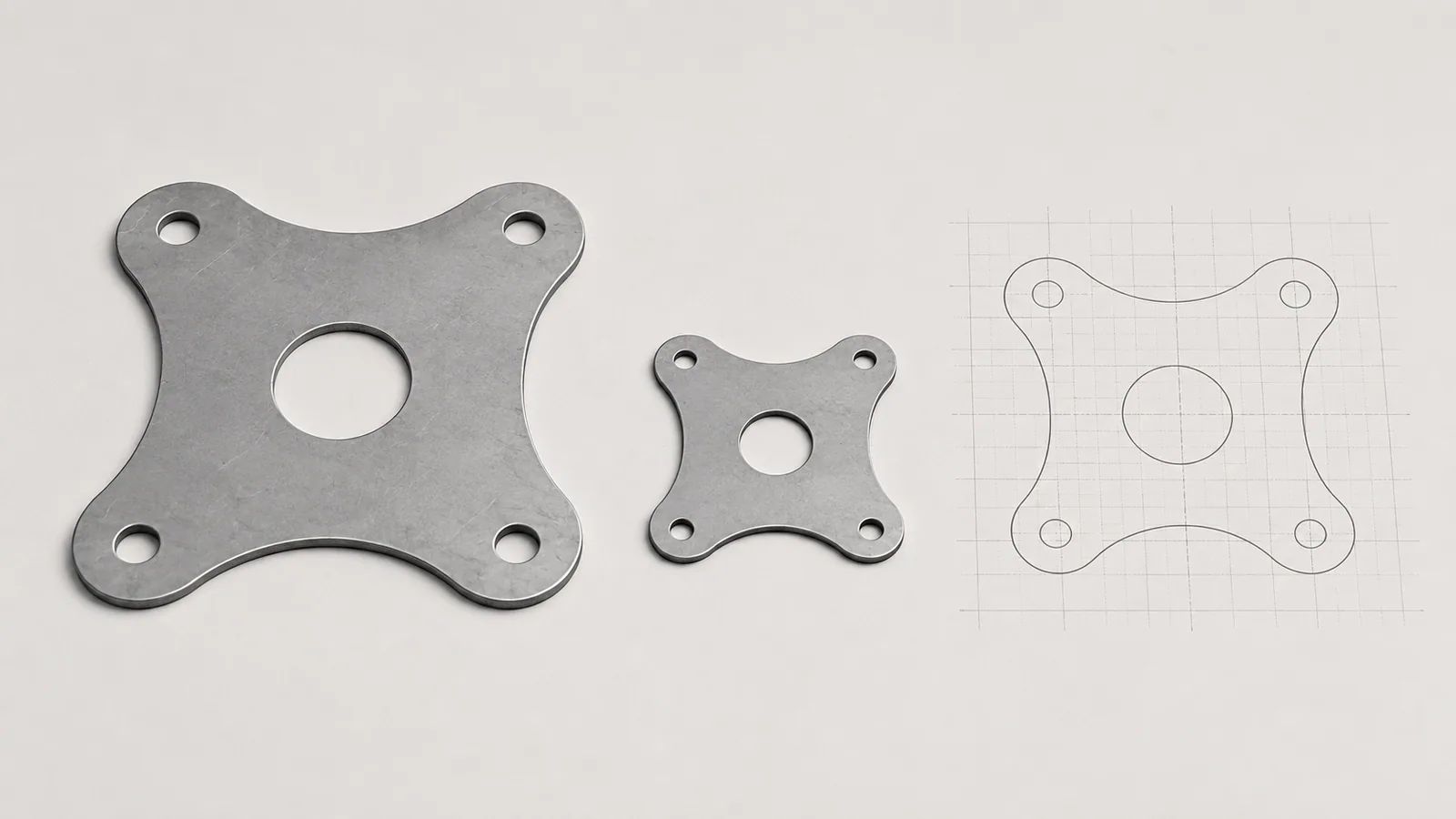
DXF units and scale: how to send a correctly sized part for cutting
Why a DXF opens too large or too small, how units differ from print scale, and how to verify dimensions before laser cutting.
Open article→220ART-473
DXF layers: separating cutting, marking and construction lines
How to separate part contours, marking and reference elements in a DXF so the manufacturer prepares the cutting operations correctly.
Open article→221ART-474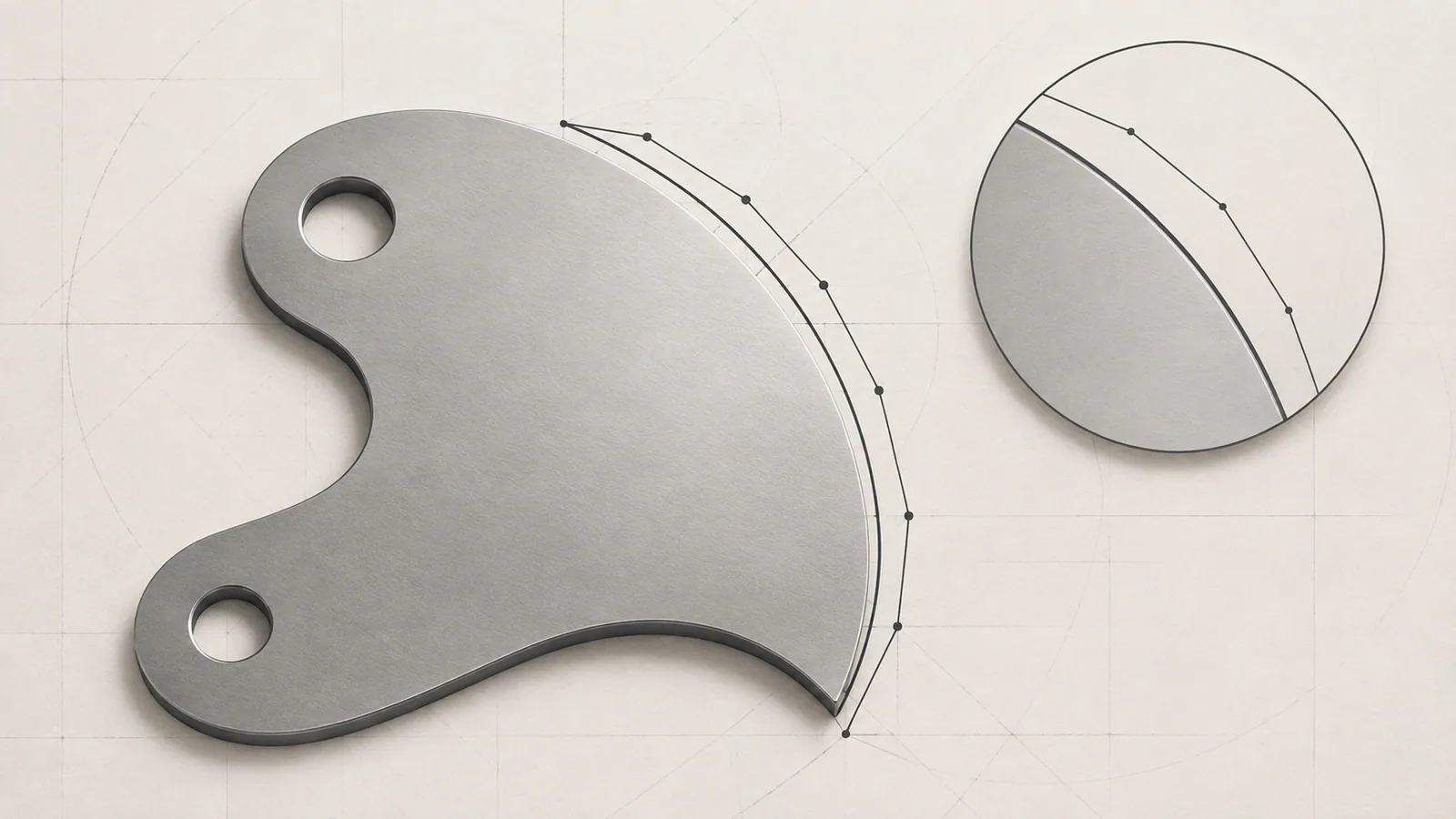
Splines, arcs and polylines: preserving a part's shape during cutting preparation
How to transfer curves from a drawing into cutting software without unwanted shape changes: line types, conversion checks and approval steps.
Open article→222ART-475
Duplicate DXF contours: removing extra lines before laser cutting
How to find duplicates and partial overlaps in a DXF, distinguish them from narrow features and check the file after cleaning.
Open article→223ART-476
Open DXF contours: finding and correctly repairing gaps
How to recognise barely visible contour gaps, distinguish them from open reference lines and repair a DXF without changing the part.
Open article→224ART-477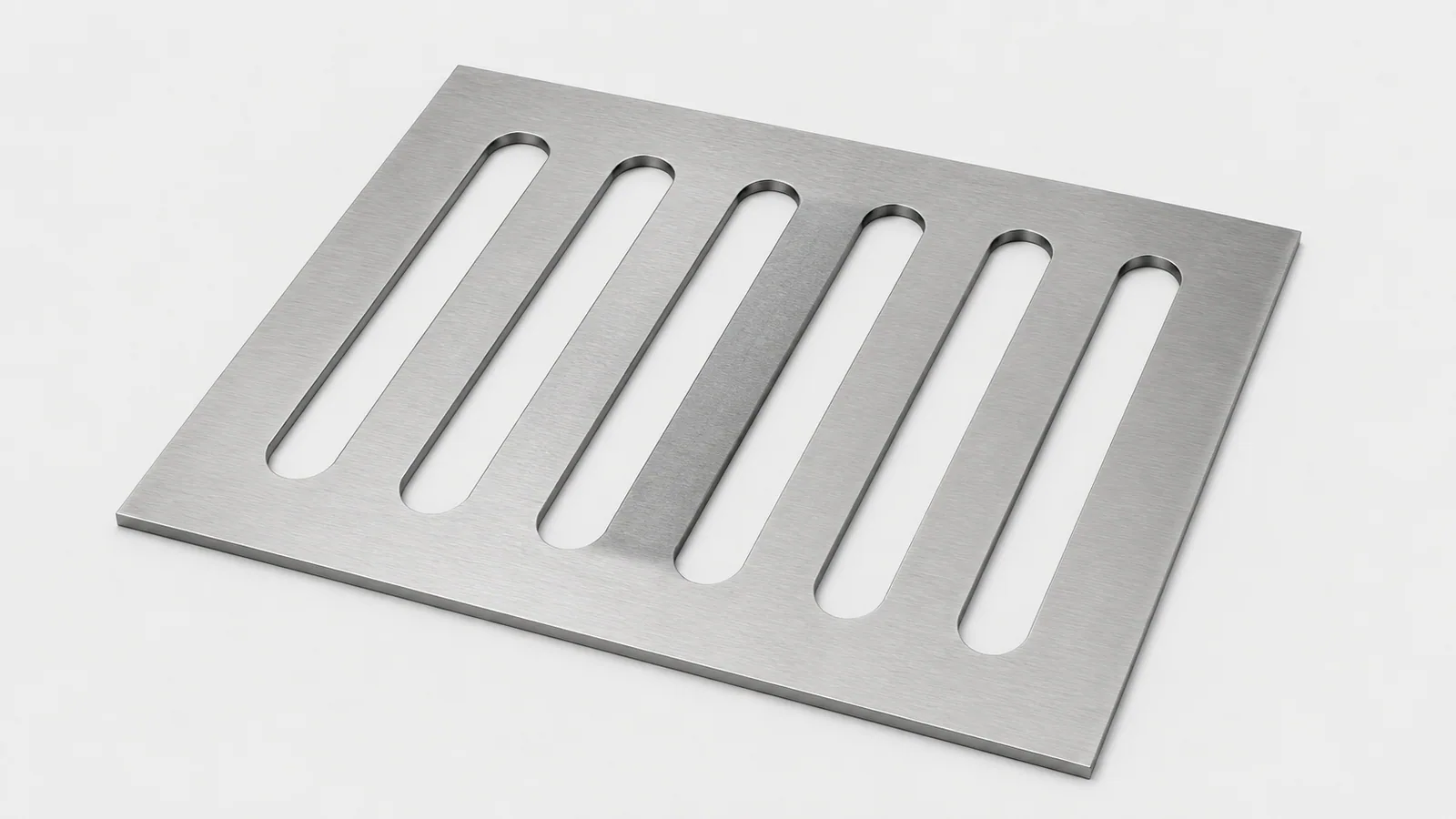
Webs between cutouts: choosing width and preserving part stiffness
Assessing narrow webs in sheet metal parts: width, length, heat, material, subsequent operations and agreement with the manufacturer.
Open article→225ART-478
Holes near sheet metal edges: checking distance and stiffness
How to measure the material remaining between a hole and an edge and assess cutting, fastening and later operations without universal assumptions.
Open article→226ART-479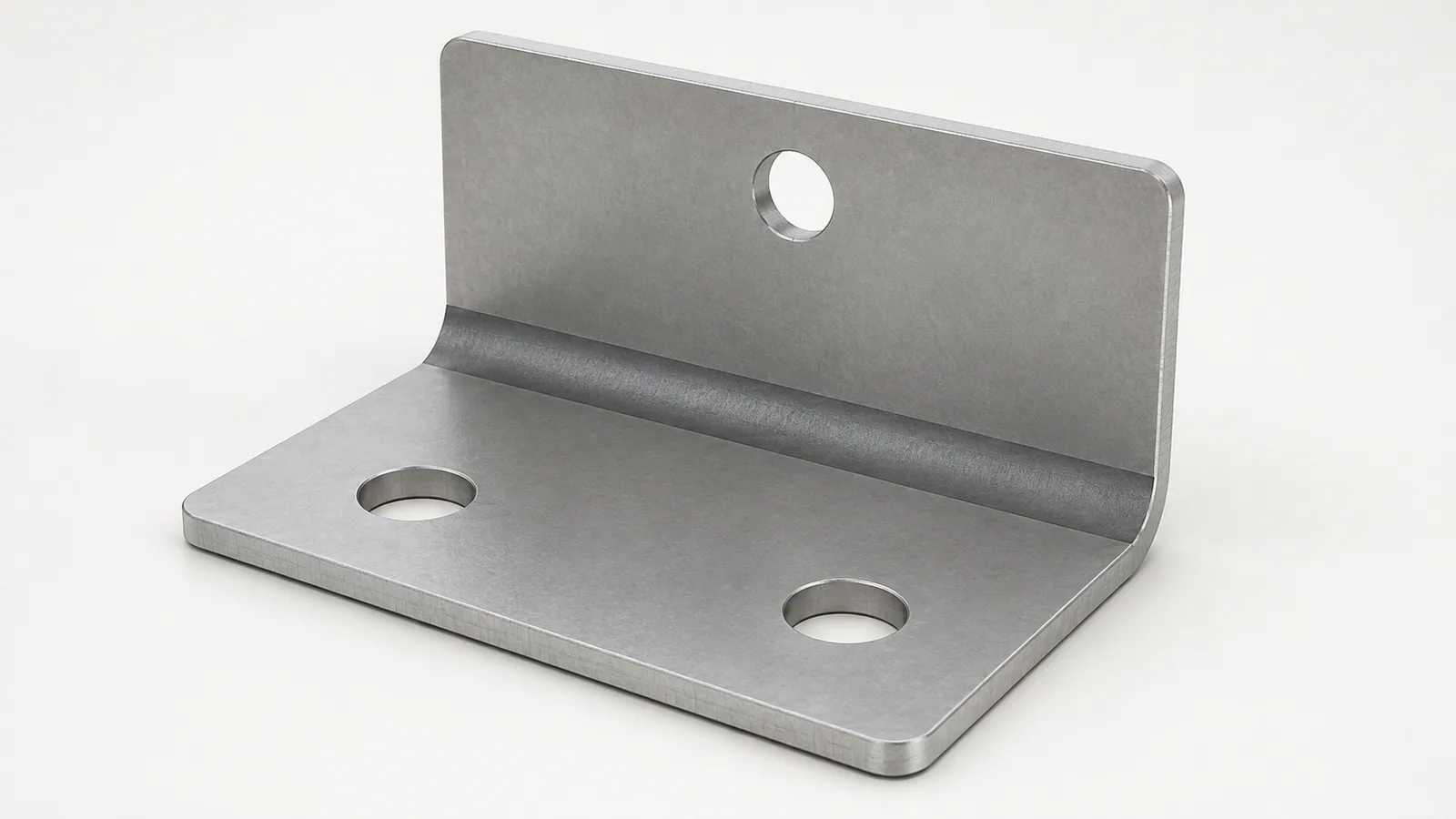
Hole-to-bend distance: preserving shape and fastener position
How to specify hole-to-bend distance, distinguish measurement references and check distortion, assembly and the finished part.
Open article→227ART-480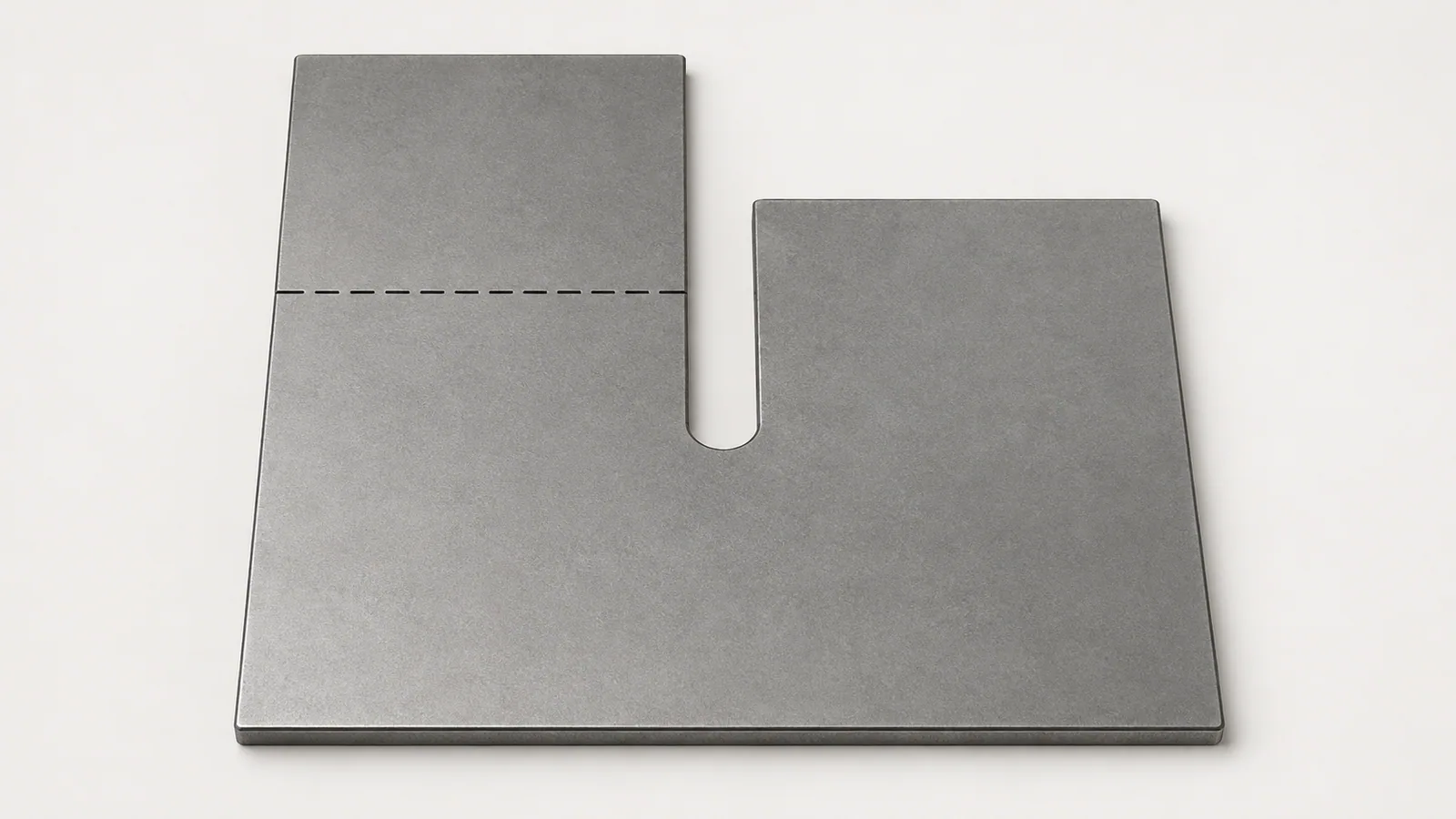
Bend reliefs: designing a clean sheet metal corner
Why bend reliefs are needed, how to choose shape and dimensions, and how to account for stiffness, joints, welding and appearance.
Open article→228ART-481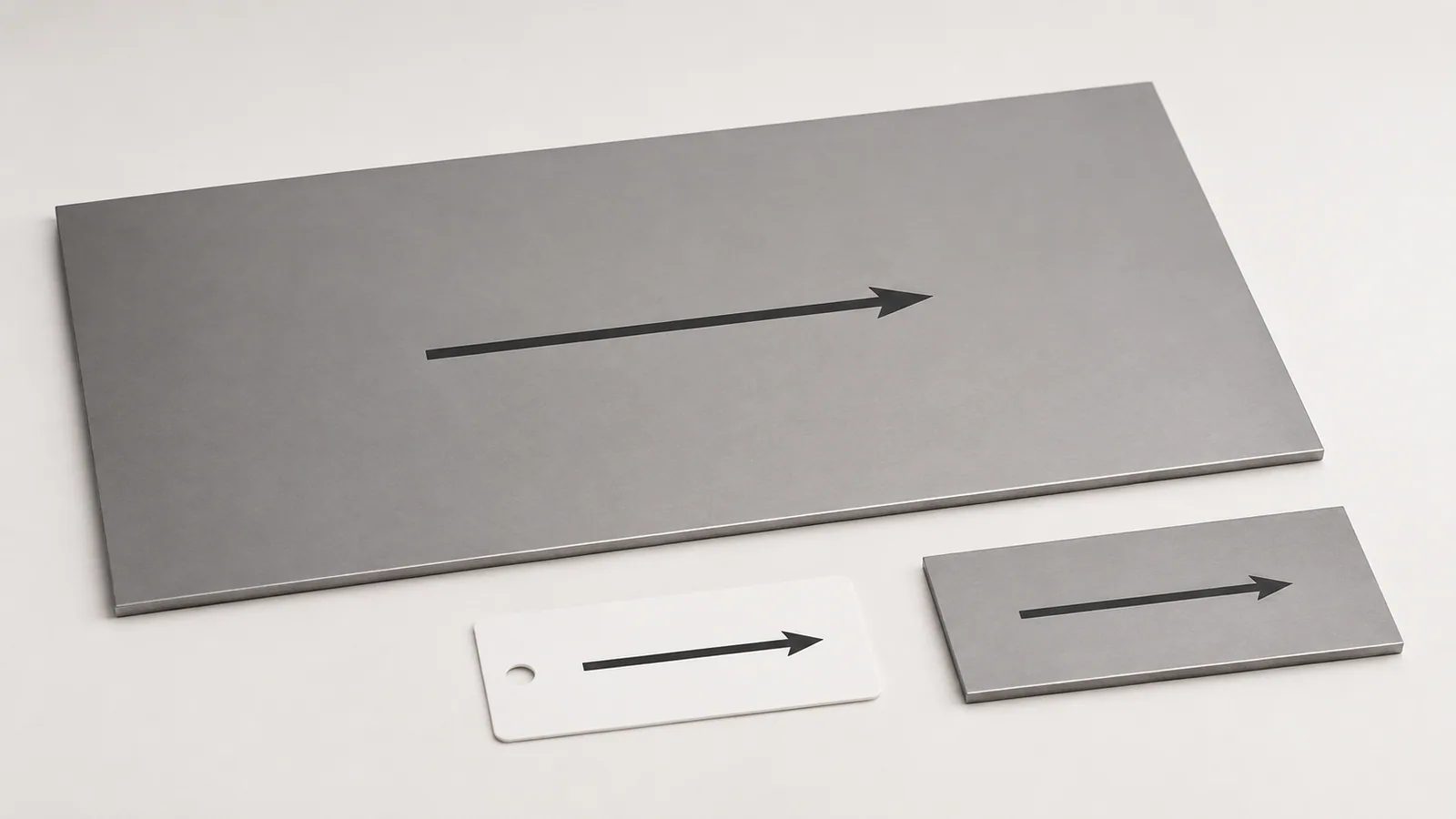
Rolling direction on a drawing: specifying and preserving sheet orientation
When rolling direction matters, how to show it relative to a bend and how to preserve it during nesting and manufacture.
Open article→229ART-511How to Prepare an RFQ for Metalworking Equipment So Quotations Can Be Compared
How to prepare one comparable request for equipment suppliers, define the production task, request a consistent response, and expose exclusions and assumptions.
Open article→230ART-512How to Check a Supplier’s Technical Specification for Gaps and Assumptions
How to turn a supplier specification into a verified list of equipment, options, site duties, acceptance evidence, risks, and open questions.
Open article→231ART-514Which Logistics Conditions Should Be Agreed Before Equipment Shipment?
A practical guide to agreeing the shipment scope, cargo places, packaging, transport documents, delivery point, responsibilities, and acceptance procedure.
Open article→