

How much material should remain between cutouts?
A web, or permanent bridge, is the strip of material left between neighbouring cutouts as part of the finished component. It must be wide enough not only for the laser to cut the shape, but also for the part to retain its form during manufacture, subsequent processing and use.
There is no universal minimum width for every part. Material, sheet thickness, the length of the narrow area, the shape of adjacent cutouts and product requirements all matter. A particular manufacturer may have verified limits for its process, but those should not be transferred to a different material or design without clarification.
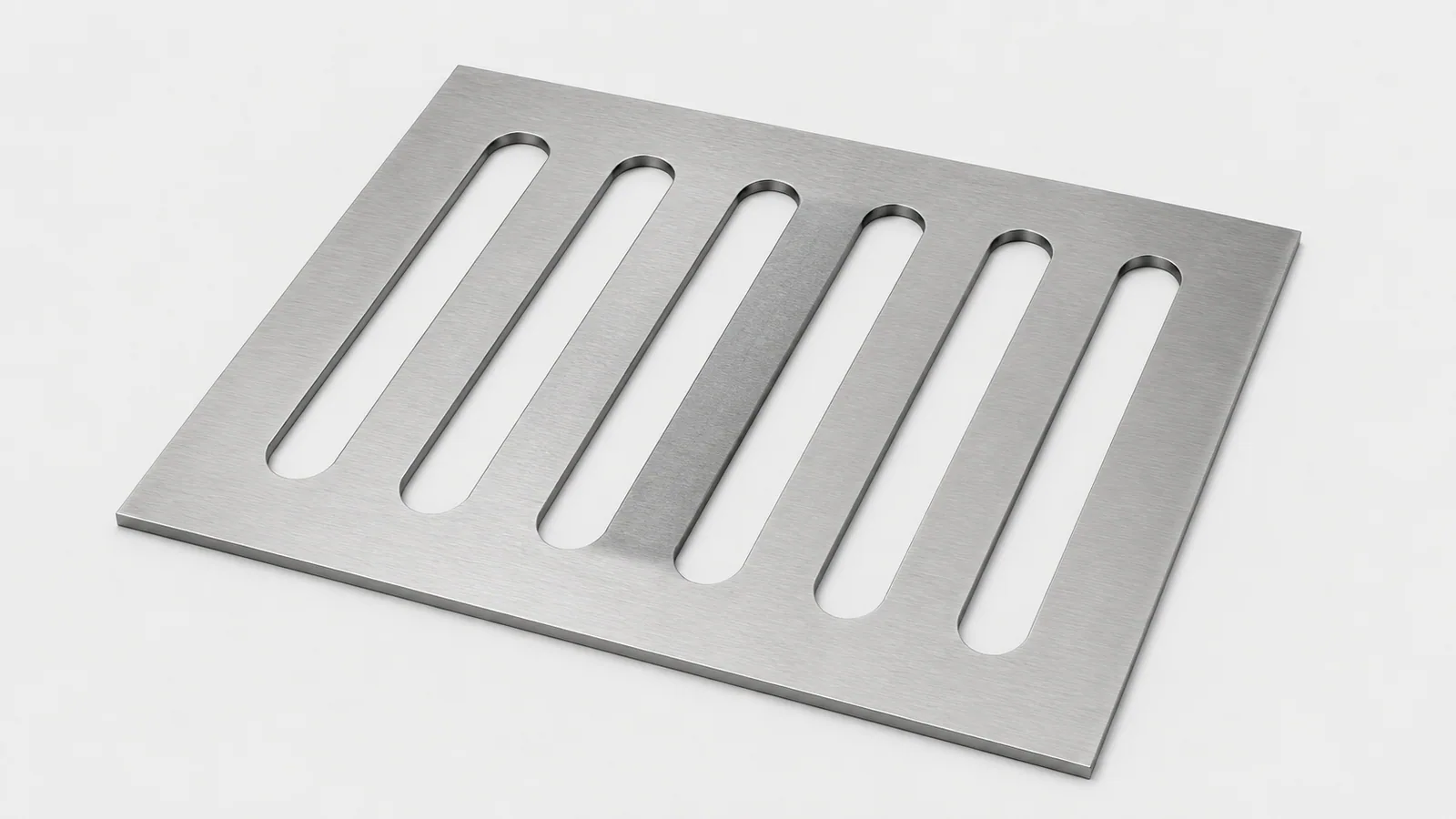
Imagine a ventilation panel with long parallel slots. Thin strips remain between them. In the drawing they look like ordinary areas of a flat surface, but once neighbouring openings are cut, each strip has much less support. That transition from a complete sheet to an openwork part needs consideration before placing the order.
Three different things often called bridges
A permanent web between cutouts remains in the product. It might connect areas of a decorative panel or form a rib in a grille. Its dimensions and shape belong to the design, so they must not be changed without agreement.
A manufacturing microtab temporarily holds a part in the sheet. It may be left during cutting preparation and later separated and dressed. Its purpose is different: it must not be confused with a permanent section needed for the finished product to work.
Spacing between separate parts in a nesting layout is another distinct dimension. It concerns the arrangement of parts on a sheet and the cutting process. Do not automatically use that spacing as a minimum for a narrow rib within a part: the rib's working and support conditions may be entirely different.
| What is meant | Does it remain in the product? | Who agrees the decision? |
|---|---|---|
| Web between cutouts | Yes | Design owner and manufacturer |
| Retaining microtab | Usually removed | Cutting preparation specialist |
| Space between parts on the sheet | No; it belongs to the layout | Manufacturer during nesting preparation |
Why width alone is not enough
Compare a short web between two circular holes with a long strip between parallel slots. Even with the same minimum width, they are different features. A long strip may be more sensitive to bending or accidental pressure, while a short section transfers loads into the surrounding material differently.
Transition shape matters too. An abrupt narrowing, a sharp internal corner or a long thin tongue may need more attention than a uniform section with a smooth transition. This does not mean rounding everything in the drawing arbitrarily: changes must preserve function and agreed dimensions.
When assessing a part, consider its narrowest point, web length and the areas to which the web connects. If it is load-bearing, assessing cutting feasibility alone is insufficient. A separate design check for operating loads is required. A part that can be manufactured is not automatically strong enough.
Specify the width of material required in the finished part, not the distance between imagined paths of the laser beam's centre. Kerf width and its compensation belong to production preparation. Adding your own allowance without agreement can cause double compensation and an incorrect dimension. If the manufacturer expects a special geometry format, discuss it explicitly.
Also distinguish nominal width from its permitted deviation. A dimension alone does not explain how much it may vary in the finished part. A functionally important feature needs clear acceptance requirements aligned with process capability. Do not demand extreme precision where it has no effect on the result, but do not leave a critical dimension unexplained either.
If the product contains many identical webs, do not check only one that is easy to measure. Edge and central areas may have different surroundings and support. The inspection plan should cover representative locations, especially those with the most neighbouring cutouts or the longest unsupported strip.
How heat affects narrow areas
Laser cutting heats the material locally in the processing zone. Where many cutouts lie close together, a narrow area may be near several successive cuts. Its condition depends not only on width but also on how heat enters and leaves it in the particular process.
Metal expands when heated and changes dimensions in the opposite direction as it cools. When neighbouring areas heat unevenly and restrain one another, distortion is possible. Residual stresses already present in the sheet may also redistribute after contours are cut and contribute to the outcome.
This does not mean every narrow web will necessarily overheat or bend. Modern equipment can produce complex parts, but process limits should be confirmed for the actual geometry. Promising that “the laser is accurate, so any strip will stay flat” oversimplifies the real task.
The roles of material and thickness
Thickness affects the section's stiffness and cutting conditions. However, “make the width equal to the thickness” is not a universal answer. Some verified processes permit smaller features; others need more margin. Understand which material and outcome a recommendation applies to.
Metals differ in properties, including thermal conductivity and mechanical behaviour. Beyond the material name, grade, delivery condition and surface requirements may matter. “It is just steel” or “we cut something similar from aluminium before” is not enough to transfer a solution confidently.
The customer does not need to calculate laser settings independently. Provide precise material information, thickness and a drawing, and ask for the narrow areas to be assessed specifically. If the manufacturer proposes a different material or thickness, also check weight, assembly, coating and the finished product's operation.
Example: improving a ventilation grille
Suppose a housing needs a ventilation panel with many long openings. Its job is to pass air, remain sufficiently stiff and look tidy. If excessively long, narrow strips remain between the slots, problems may appear not only during cutting but also during part removal or subsequent painting.
One possible improvement is to shorten continuous slots and introduce cross-connections. Another is to change the number or pitch of openings, or retain a wider frame around the perforated area. Each option has consequences: open area, appearance and stiffness change. The decision therefore cannot be based solely on cutting convenience.
Start by identifying which requirements are genuinely fixed. If a particular open area is needed for airflow, it must be preserved or recalculated. If the panel prevents access to moving parts, its geometry must not change without checking the relevant safety requirements. The manufacturer helps assess production, while the design owner confirms whether the change is acceptable.
What the manufacturer can do without changing your part
The cutting preparation specialist can assess operation order, sheet layout, part support and the need for retaining features. Sometimes a properly organised process can produce difficult geometry without changing the drawing. But that needs to be a confirmed solution, not a customer's assumption.
Do not prescribe a universal sequence such as “always cut every other hole” or “always leave the outer contour until last.” Such approaches may be appropriate in certain circumstances, but the specialist must consider the actual part, equipment and layout.
Nor should an anticipated defect be compensated by deliberately distorting the drawing. If a narrow strip bends in a trial part, investigate the cause and agree a solution. Moving lines by eye without control may merely introduce a different error that appears in the next batch.
When a trial part is worthwhile
Trial manufacture is useful when the geometry is new, webs are critical or a series-production error would be expensive. Test a sufficiently representative section or the whole part, not simply an isolated short strip, so the conditions match the question being investigated. A small coupon does not always reproduce the behaviour of a large perforated panel.
Agree beforehand what counts as an acceptable result. Criteria may include web dimensions, flatness, freedom from cracks, edge condition and the ability to assemble the part. “It looks fine” is convenient in conversation but weak as an acceptance criterion when the part has a specific function.
Check more than its condition immediately after cutting. If deburring, bending or coating follows, thin features must survive those operations too. One successful sample is not an unconditional guarantee for any batch, but it provides useful evidence for the agreed material, geometry and process.
Discuss transport separately. Long thin features can be damaged by unsuitable handling or packaging even when cutting was done well. Protection during transport does not repair a weak design, but it helps preserve the result already achieved. For decorative parts, agree which surface handling marks are acceptable too.
Information that helps obtain a specific answer
Provide a drawing or model with narrow areas marked, plus material, thickness, quantity and the product's purpose. State which dimensions can change and which are tied to assembly or function. This allows the manufacturer to propose a specific solution instead of a general warning about “complex geometry.”
For example: “Panel with ventilation slots. The narrowest webs are marked in the drawing. Overall dimensions, mounting points and the agreed open area must be preserved; changes to the slot pattern can be discussed. Painting follows cutting. Please assess manufacturability and whether a trial sample is needed.” This explains both the problem and the scope for improvement.
Do not demand a single number without reference to the file. Confirmation of your actual geometry, or a list of specific areas requiring changes, is much more useful. Save the final decision with the drawing revision so repeat orders do not return to the original version.
Discuss manufacturing a part with narrow websMaking a decision without unnecessary margin or risk
A good web is not necessarily the widest possible one. It must perform its function, be manufacturable and withstand later operations. Excessive margin also has a cost: it may reduce ventilation, change appearance or increase weight. The aim is therefore a justified design, not arbitrary thickening of every feature.
The decision sequence is straightforward: establish the web's function, assess its width and length, specify material and thickness, discuss the process with the manufacturer and test a sample where necessary. If the part carries loads or performs a protective function, the appropriate design verification is additionally required.
Above all, treat the narrow area as part of a real product rather than merely a space between two lines. Then “What is the minimum?” becomes a more useful question: “Which web will work reliably in this particular part and the agreed process?”