

Suitable applications
Repeat annular, circular and spatial seams on parts that can be held consistently in a rotary fixture. The path, workpiece position and wire feed are agreed from the drawing and a welding trial.
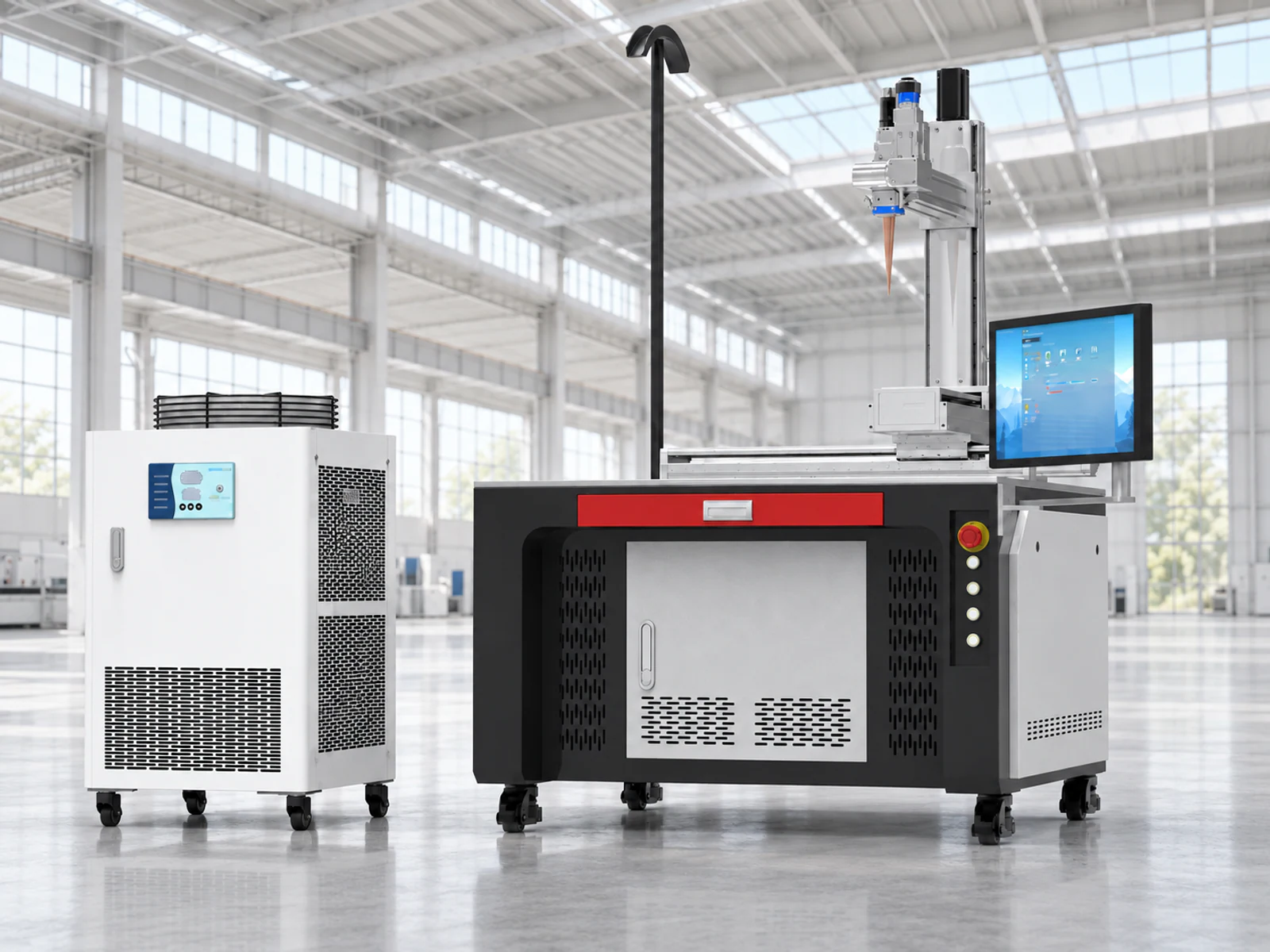
The image is for reference. Actual appearance and configuration may vary.
Article: 10009
An automatic system for flanges and repeat parts with X/Y/Z linear axes and two rotary axes, W1 and W2.
Five controlled axes combine linear head movement with workpiece rotation and tilt. This is a separate automatic machine, not a tabletop version of the handheld MK-HW.
Automatic welding cycle
MR-AW-FL1500W overview
Repeat annular, circular and spatial seams on parts that can be held consistently in a rotary fixture. The path, workpiece position and wire feed are agreed from the drawing and a welding trial.
MR-AW-FL1500W automates the path and workpiece position, so compare it with handheld welding through batch repeatability, setup time and seam access. Five axes do not remove the need for accurate location, joint preparation and a controlled laser area.
| Model | Source power, kW |
|---|---|
| MR-AW-FL1500W | 1.5 |
| Positioning accuracy, mm | ±0.08 mm/m |
|---|---|
| Positioning repeatability, mm | ±0.05 mm/m |
Selection requires drawings, material, thickness, seam geometry, allowable joint gap and planned volume. The working process is confirmed on samples.
The proposed equipment includes a 1.5 kW fiber source, linear motion module, rotary fixture, welding head, wire feeder, viewing camera and dual-circuit cooling. Final component makes and fixture design are recorded in the specification.
The values below describe the proposed MR-AW-FL1500W configuration. The source document's general reference to thickness up to 5 mm is not a guaranteed working range: material, joint, gap, gas and weld position are checked separately.
| Parameter | Value |
|---|---|
| Laser source power | 1500 W |
| Wavelength | 1070 nm |
| X / Y / Z travel | 1000 × 1250 × 500 mm |
| Positioning accuracy | ±0.08 mm/m |
| Repeat positioning | ±0.05 mm/m |
| W1 / W2 rotary axes | continuous rotation / 0–90° |
| Wire diameter | 0.8 / 1.0 / 1.2 / 1.6 mm |
| Head scan width | 0.5–6 mm |
| Source-listed joint gap | up to 0.5 mm; trial confirmation required |
| Electrical supply | 220 V ±10% |
| Total consumption | up to 12 kW |
| Operating conditions | 15–35 °C; humidity <70%, non-condensing |
| Packing dimensions / weight | 1500 × 2000 × 1800 mm / 1000 kg |
The source document names different servo manufacturers in separate sections. The public page therefore states the function; the exact make is confirmed in the final specification.
These are points listed in the source table, not guaranteed penetration for every joint. The final process depends on alloy, edge preparation, gap, gas and seam requirements.
| Material | Shielding gas | Listed thicknesses, mm |
|---|---|---|
| Stainless steel | Argon | 0.5 / 0.8 / 1.0 / 1.2 / 1.5 / 2.0 |
| Carbon steel | CO₂ | 0.5 / 0.8 / 1.0 / 1.2 / 1.5 / 2.0 |
| Galvanized steel | Argon | 0.5 / 0.8 / 1.0 / 1.2 / 1.5 |
| Aluminum | Nitrogen | 1.0 / 1.2 / 1.5 |
Automated motion does not replace fixturing: the workpiece must locate consistently and the path must avoid collisions involving the head, cables and rotary fixture.
Commissioning requires a risk assessment, controlled laser area, restricted access, suitable screens and eyewear for the source wavelength, and welding-fume extraction.
Send a drawing or photograph of the part, material, thickness, blank size and required output. This lets us compare configurations against your job, not just their power rating.
Tell us what you would like to clarify. Add drawings, photos or the required configuration reference to your request if available.
Discuss configuration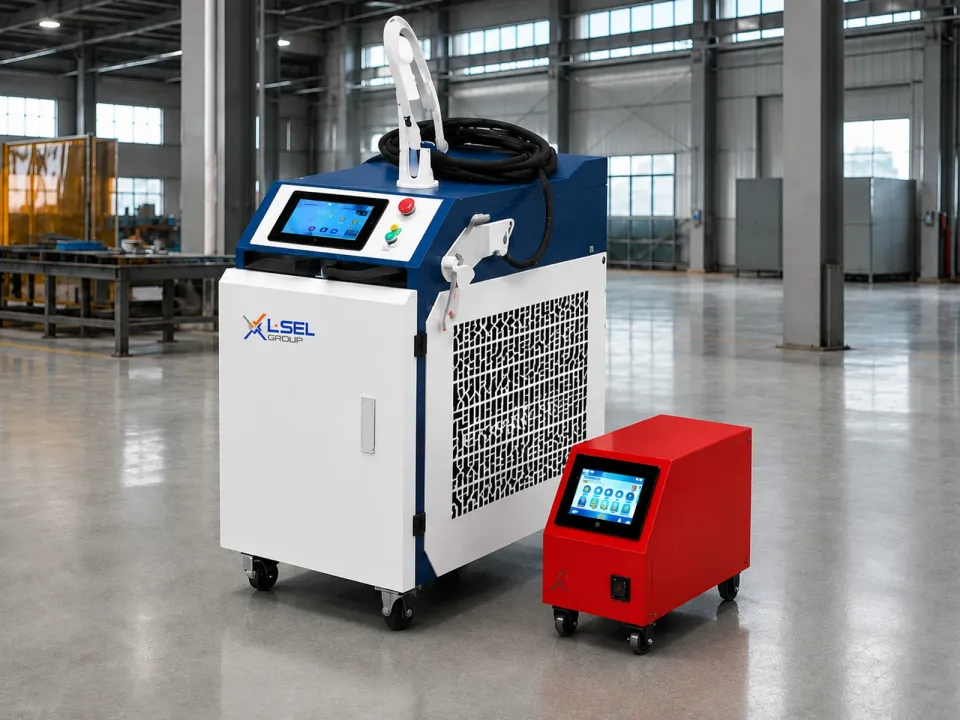
MK-HW2000, MK-HW3000
Article: 10008
A compact water-cooled welding system with a handheld head. Configuration is selected for the material, joint and workplace conditions.
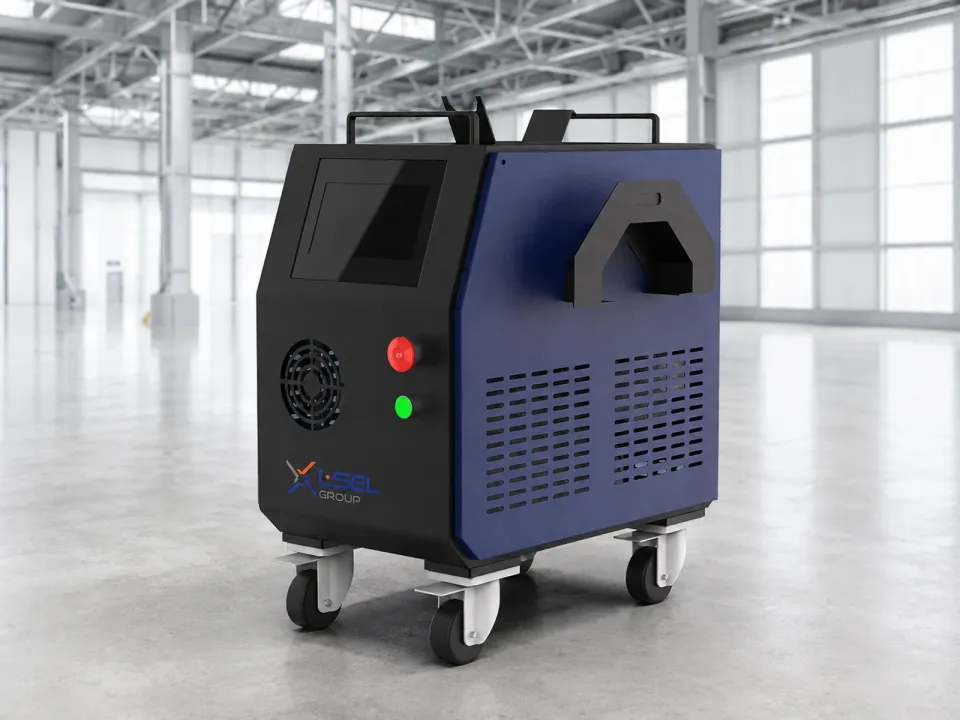
MK-AW
Article: 10075
A compact mobile system for handheld laser welding. Air cooling simplifies the arrangement without a separate water chiller.
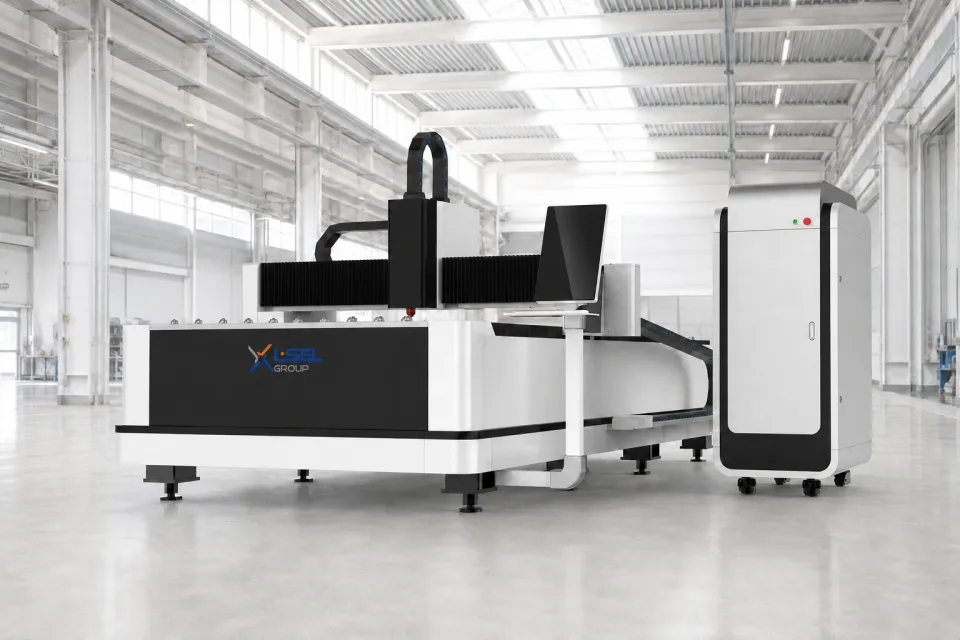
LF3015CN
Article: 10001
A single open 3000 × 1500 mm table with direct sheet access. A model for straightforward stock logistics and a configuration matched to the actual job.